

Launching a pickleball paddle brand involves more than choosing a paddle shape or adding your logo. The materials, core structure, manufacturing process, surface finish, and weight all influence the final product.
For new brands, these choices can be confusing. Should you choose T700 raw carbon fiber? Is a thermoformed paddle the right option? What is the difference between Gen 3 and Gen 4 polypropylene (PP) honeycomb cores? And is a silicon carbide (SiC) surface worth considering for a differentiated product line?
This guide explains the key decisions brands should consider when developing a custom pickleball paddle with an OEM or ODM manufacturer.
1. Start with the Paddle Surface: T700 Carbon Fiber or Silicon Carbide?
The paddle surface is one of the first decisions to make when developing a product. Two options worth exploring for different product strategies are T700 raw carbon fiber and silicon carbide (SiC) surface technology.
T700 Raw Carbon Fiber
T700 raw carbon fiber is a popular choice for performance-oriented pickleball paddles. It offers a lightweight, stiff surface structure and is widely used in premium paddle development.
Brands considering T700 should evaluate:
- The surface texture and finishing process
- Compatibility with the selected core and construction
- Target weight and balance
- Intended price positioning
- The desired playing feel and performance characteristics
T700 carbon fiber is a practical starting point for brands seeking to develop a performance-focused paddle using an established material category.
Silicon Carbide (SiC) Surface Technology
Silicon carbide is another surface technology to consider when developing a differentiated paddle. For brands looking beyond conventional carbon fiber surface options, SiC provides an opportunity to explore a different surface texture and product positioning.
When evaluating an SiC paddle, consider the surface finishing method, texture consistency, wear resistance, printing compatibility, and the performance of the complete paddle.
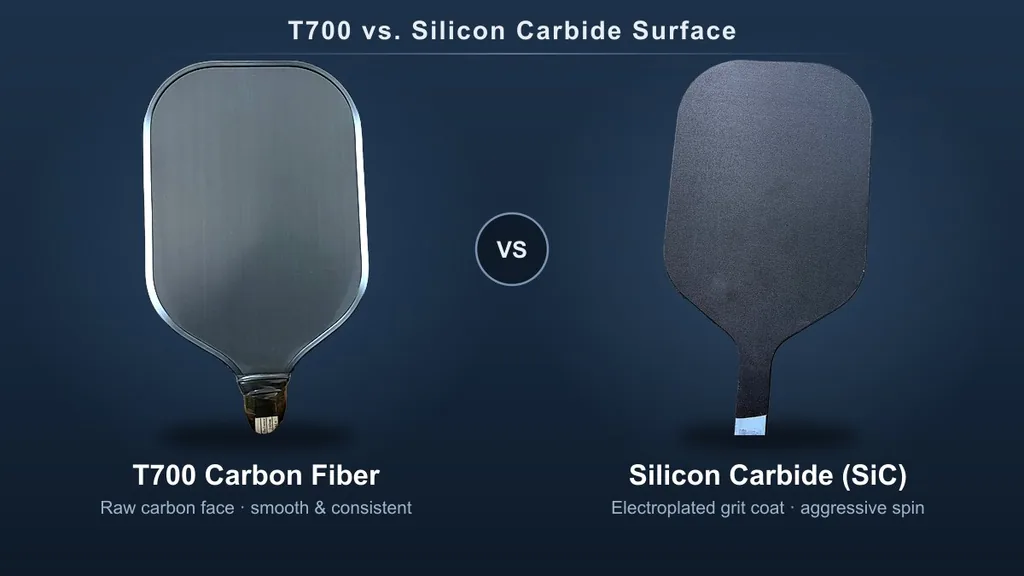
T700 is a sensible starting point for a conventional performance-oriented product. SiC may be worth exploring if your brand wants to develop a differentiated surface offering. The best choice depends on your target customers, budget, and product development goals.
2. Why Thermoformed Construction Matters
Surface material and paddle construction are two different decisions. T700 describes the carbon fiber material used on the paddle face. Thermoforming describes a manufacturing approach used to form and bond the paddle structure.
Thermoformed paddles are often developed with a formed perimeter and may incorporate foam injection around the edges, depending on the design.
For brands evaluating a thermoformed paddle, important considerations include:
- Structural consistency
- Edge and perimeter construction
- Weight and balance
- Core compatibility
- The intended feel and performance profile
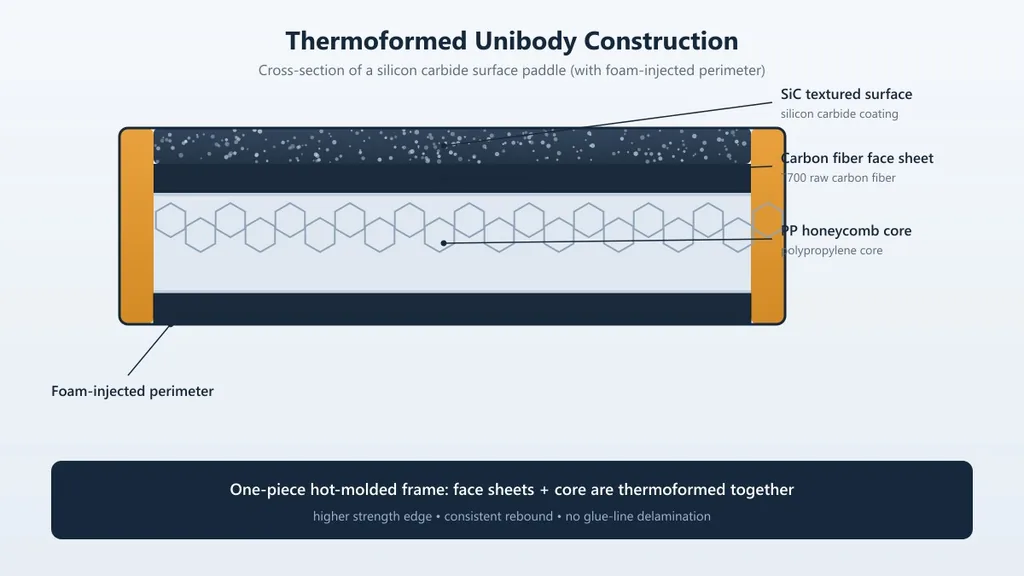
When requesting a quotation, specify whether you need a thermoformed unibody construction and whether foam injection around the perimeter is required. These details can affect the available model, tooling, and production cost.
For a new brand, using an existing mold that closely matches the intended specifications may also help simplify the initial development process.
3. Gen 3 vs. Gen 4 PP Honeycomb Core: What Is the Difference?
Polypropylene (PP) honeycomb is a common core option for pickleball paddle development. However, different core designs can produce different playing characteristics.
Gen 3 and Gen 4 PP cores should be evaluated according to their actual construction and the complete paddle design, rather than by generation name alone. For a broader material comparison, see our guide to the PP honeycomb core vs. EPP foam core.
Gen 3 PP Honeycomb Core
A Gen 3 core may be suitable for brands evaluating an established PP honeycomb paddle platform. When comparing models, consider the paddle’s stability, response, control, power, and feel. These characteristics also depend on the surface material, thickness, shape, and overall construction.


Gen 4 PP Honeycomb Core
In the core designs offered by GloryPaddle, the Gen 4 option has a larger sweet spot than the Gen 3 option, as illustrated in the core comparison above. A larger sweet spot can be a useful consideration for brands seeking a more forgiving hitting area. The actual playing experience should be evaluated using samples with comparable specifications.
How Should You Choose?
| Consideration | What to Evaluate |
|---|---|
| Sweet spot | How forgiving the paddle feels on off-center hits |
| Control | How consistently players can direct the ball |
| Power | How the complete paddle responds during attacking shots |
| Stability | How the paddle feels during contact |
| Feel | The overall feedback from the surface, core, and construction |
| Cost | The price difference between the available core options |
If you are uncertain which core to select, request samples of both generations with the same surface material, thickness, shape, and target weight wherever possible. This makes the comparison more meaningful.
4. How Surface, Core, and Construction Work Together
A paddle should not be evaluated by one material specification alone. Two paddles may both use T700 carbon fiber but differ in core generation, thickness, shape, weight, and manufacturing process. Their playing characteristics may therefore differ.
Likewise, selecting a silicon carbide surface does not automatically determine the paddle’s power, control, or stability.
A complete OEM specification should consider:
- Surface: T700 raw carbon fiber, SiC surface, or another suitable option
- Core: PP honeycomb or another compatible core structure
- Construction: Thermoformed or bonded construction, depending on the model
- Thickness: Based on the intended product design
- Weight and balance: Matched to the target market
- Shape and handle: Designed for the intended player and brand positioning
- Graphics and finish: Selected with surface performance and production compatibility in mind
Working through these details together helps reduce misunderstandings during sampling and quotation. For an overview of the technologies behind every GloryPaddle build, visit our technology page.
5. What Should New Brands Ask an OEM Manufacturer?
Before requesting a sample or production quotation, prepare a basic product brief. Include the following information where available:
- Target market: Who will use the paddle, and what price range are you targeting?
- Surface material: Are you considering T700 carbon fiber, SiC, or another option?
- Core structure: Do you prefer PP honeycomb, and do you want to compare different core generations?
- Construction: Do you require thermoformed construction and a foam-injected perimeter?
- Dimensions and weight: Specify the intended paddle thickness, shape, weight, and handle dimensions.
- Artwork: Provide your logo, graphics, preferred colors, and editable artwork files if available.
- Quantity: State your sample requirements and estimated first production quantity.
- Packaging: Indicate whether you need standard protective packaging or a customized retail box.
You do not need to know every technical detail before contacting a manufacturer. A clear target market, approximate budget, and desired product characteristics provide a useful starting point for a development discussion.
6. Why Sample Evaluation Is Important
Product specifications are essential, but they cannot fully replace hands-on evaluation. Before confirming a bulk order, brands should review sample weight, balance, grip dimensions, surface finish, construction quality, and overall playing feel.
For brands comparing Gen 3 and Gen 4 cores, testing both options under comparable conditions can help identify the preferred construction.
For a new SiC surface, ask about the surface process, available durability information, compatibility with artwork, and any applicable certification status for the exact model.
Do not assume that changing the surface, graphics, core, or construction will leave every performance characteristic unchanged. Confirm the final specification before mass production.
7. Develop Your Custom Pickleball Paddle with GloryPaddle
GloryPaddle supports OEM and ODM pickleball paddle development for brands, distributors, clubs, and private-label businesses.
Depending on the selected model and project requirements, development options may include:
- T700 raw carbon fiber surfaces
- Silicon carbide surface technology
- PP honeycomb core options
- Thermoformed paddle construction
- Custom paddle shapes and specifications
- Logo and artwork customization
- Private-label packaging
Whether you are launching your first paddle or expanding an existing product range, the first step is to define your target customer and preferred product direction.
Frequently Asked Questions
Is T700 carbon fiber the same as a thermoformed paddle?
No. T700 refers to the carbon fiber material, while thermoforming refers to a manufacturing process. A paddle specification should identify both the surface material and the construction.
What is the difference between Gen 3 and Gen 4 PP cores?
The differences depend on the specific core designs. In GloryPaddle’s current comparison, Gen 4 has a larger sweet spot than Gen 3. Sample evaluation is recommended to compare the overall playing feel.
Is a silicon carbide surface better than T700 carbon fiber?
Neither option should be considered universally better. T700 and SiC represent different surface approaches. Compare the finished paddle’s playing characteristics, surface durability, manufacturing consistency, and target price.
Can I customize a paddle if I am starting a new brand?
Yes. Depending on the model and order requirements, OEM/ODM projects may include surface selection, core options, shape, weight, artwork, branding, and packaging. Confirm the available specifications and minimum order quantity with your manufacturer.
Ready to build your own pickleball paddle line?
Tell us your target specs, quantity and market. Our engineering team will reply with a factory-direct quote and a sampling plan within 24 hours.
Prefer to talk first? WhatsApp +86 136 3257 3494 or email sales@glorypaddle.com — we usually reply within a few hours.